KIT News

All News

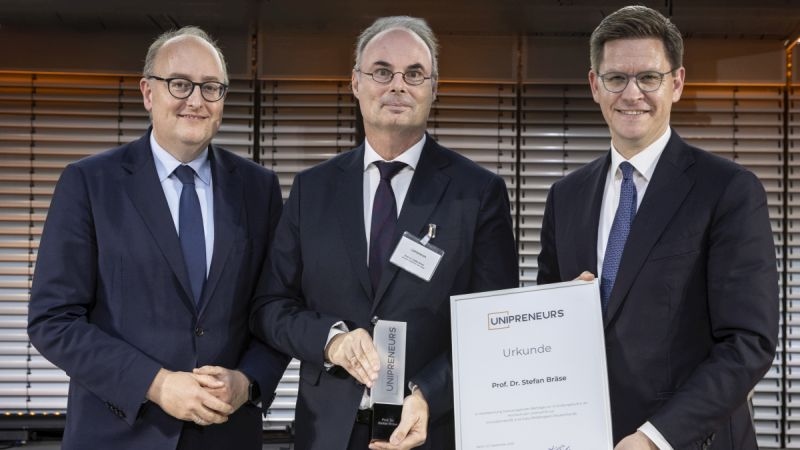
Nachwuchsförderung: Schroff-Hochbegabten-Stipendien vergebenSilke Walz, KIT
Promoting Young Talent: Schroff Scholarships Awarded to Gifted Students

17 students at KIT receive scholarships from the Gunther Schroff Foundation for Scientific Purposes

Learn more
Scenarios for a New “Iron Age”: Iron Complements Hydrogen as an Energy CarrierJ. Hebel, TU Darmstadt
Scenarios for a New “Iron Age”: Iron Complements Hydrogen as an Energy Carrier

A KIT study explores the potential of iron powder for long-term energy storage, energy transport, and the use of existing power plant infrastructure into future energy systems

Learn more
New Professorship Strengthens Research on Responsible AI at KITLinda Sagnier Eckert, KIT
New Professorship Strengthens Research on Responsible AI at KIT

How AI can become more understandable and reliable – and the benefits it brings to everyday life and work

Learn more
CO₂ Instead of Oil: New Technology for a Greener Chemical IndustrySandra Göttisheim, KIT
CO₂ Instead of Oil: New Technology for a Greener Chemical Industry

KIT recognizes a project turning CO₂ into a sustainable chemical feedstock, along with other innovations for everyday life and industry

Learn more
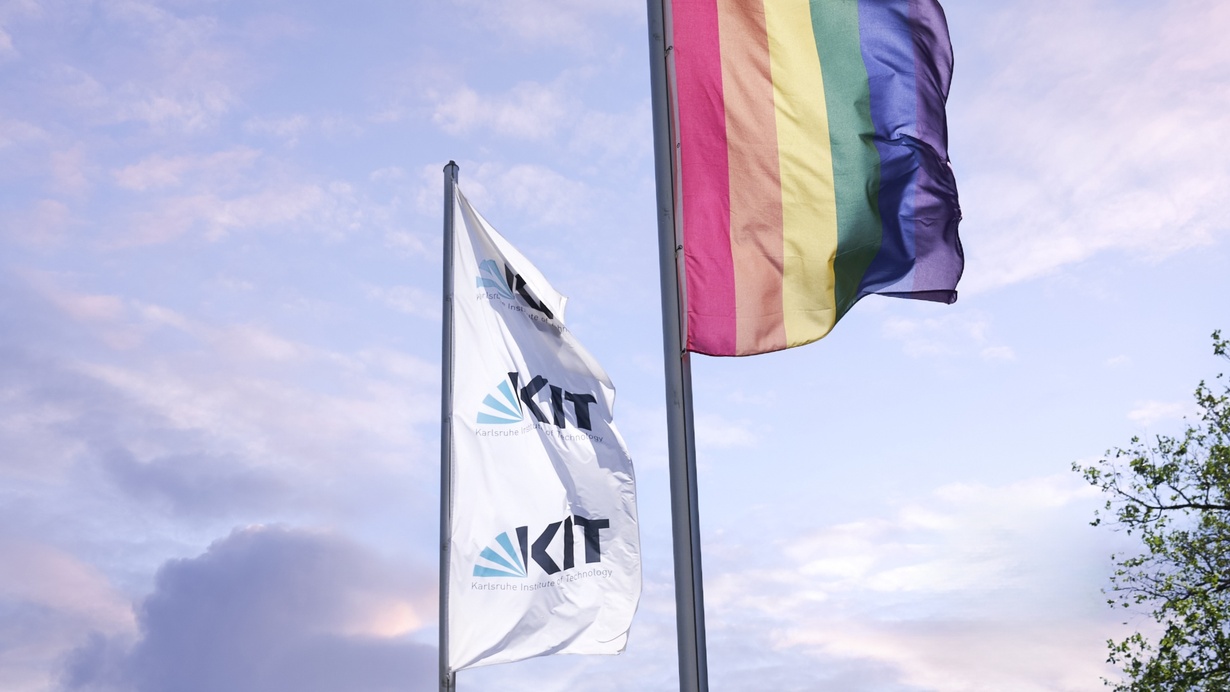
Two flags - one white with KIT logo, the other a rainbow flag - flying against a blue sky. KIT
For Diversity and an Open Dialogue

Democracy, internationality, and diversity are among the guiding principles at KIT.

Learn more
Cover of the current issue of lookKIT KIT
Transfer

The current issue of lookKIT highlights innovative solutions and technology transfer.

Learn more
3D polygonal mesh model of a human heart, showing anatomical structure in a low-poly style. Axel Loewe, KIT
AI in Cardiology

The latest episode of the “Nachgefragt” podcast explores what algorithms can detect in heart rhythms.

Learn more
Studierende am KIT KIT
Degree Programs

About 100 bachelor’s and master’s programs at KIT.

Learn more

Excellence

As a University of Excellence, KIT strengthens excellent research, maintains intensive dialog with society, and offers reliable career paths.

Science for Impact

Firmly rooted in social responsibility, KIT contributes to the shaping of a sustainable and resilient future.

Events

Compact Accelerator-driven Neutron Source Karlsruhe (CANSKA)

Compact Accelerator-driven Neutron Source Karlsruhe (CANSKA)

July 06, 2026 11:00 - 12:00KIT Campus Nord, INR, Bau 521, 2. OG, Raum 302
In future fusion reactors based on DT-fusion, in-vessel components like the breeding blanket, divertor and limiter will be subjected to extreme conditions regarding the 14 MeV neutron flux, heat and -radiation of the burning plasma. In particular, the breeding blanket has a key role. It dissipates the heat generated from fusion, breeds the fusion fuel tritium and serves as radiation shield. For the nu-clear qualification of breeding blanket materials and components, fusion relevant neutron sources are necessary. A prominent example is the International Fusion Materials Irradiation Facility - DEMO Oriented Neu-tron Source (IFMIF-DONES), which is currently under construction. The main objective of IFMIF-DONES is to provide a database for structural materials. For the qualification of breeding blankets, integrated tests of mock-ups under a relevant nuclear environment become increasingly important. This requires one or more complementary irradiation facilities. The Compact Accelerator-driven Neu-tron Source KArlsruhe (CANSKA) is projected to address this qualification gap. The baseline of the CANSKA project aims at a linear accelerator, accelerating protons and/or deuterons on a target pro-ducing high energy neutrons with a neutron flux density of the order of 1013 n/cm2/s in the test volume immediately behind the target delivering typically 3-5 dpa within few years of high-availability opera-tion. As such, CANSKA focuses on early irradiation effects and a pre-selection of the most attractive designs for subsequent full qualification campaigns at other facilities. The seminar provides an overview of the concept, the scientific goals and the resulting specifications focusing on the accelerator and target.
Herr Björn Brenneis, Karlsruher Institut für Technologie

to event calendar